Marmalade Brand Guidelines 2025
A 48-slide brand guideline deck for a community publisher, built on a black and pale grey foundation with neon accents, a serif headline and sans body type pairing, numbered black section dividers and edge-cropped display headlines.
Summary
Brand guidelines for Marmalade Collective that reposition the publisher as a community-first platform. The 48 slides prescribe a monochrome foundation with neon accents, a serif and sans type system, a three-mode photography direction and a sub-brand naming rule, closing on a staged 2025 rollout.
Visual description
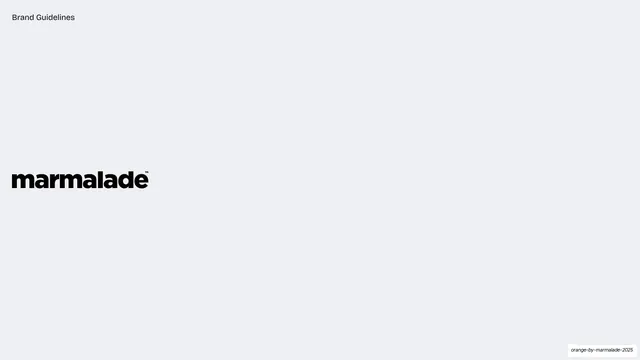
The cover is a pale grey field with one black wordmark set left at mid-height and a small running header in the top-left corner, so the deck opens with almost no decoration. Section dividers are full-bleed near-black slides with a large numeral, the chapter title in white sans-serif beside a small wordmark pinned to the right edge, and they repeat identically across the introduction, logo, colour, typography, photography and applications chapters. Content pages use a fixed three-column rhythm: a running header at the left, a short section label near the centre, and a text column on the right half, on either pale grey or black grounds. Statement slides carry oversized display type that runs off the side or bottom edge, pairing a light, high-contrast serif for the key words with a small sans for connecting words such as MEETS, NOT and ROLLING OUT THE. Photography is shown full-bleed or split into three equal frames, with the headline laid directly over the image, and the three named treatments (portrait, documentary and artistic) each get their own specimen page. Logo and colour pages are plain: approved lockups on black, a ten-tile usage grid marked with ticks and crosses, and HEX-labelled swatches with black and white as the base. Application pages use flat browser-tab, favicon and social-avatar mockups, and the Instagram-style carousel mockups use editorial covers with a black call-to-action panel to close each sequence. The orange-to-magenta gradient appears only as full-slide fields on the agenda and closing pages, so the saturated colour is kept to chapter openers.
Key takeaway
- A monochrome system carries the whole brand, and neon is used sparingly as the accent, which keeps the deck legible across 48 slides.
- Oversized serif headlines cropped by the slide edge create energy with no extra graphics, and they pair cleanly with small sans connecting words.
- Identical numbered dividers and a repeated running header make a long guideline deck easy to scan and navigate.
- Photography is defined as three named treatments with their own pages instead of one look, which gives a reusable pattern for art-directing mixed image sources.
Reuse notes
- Reach for this when building brand guidelines for a media or community publisher that needs a sub-brand naming rule and a clear section structure.
- It is a strong reference for numbered section dividers, edge-cropped display headlines and carousel-style social mockups.
- Saturated colour appears only on the opening and closing pages, so copy that pattern rather than using the gradient as an everyday background.
- The typefaces named on the specimen slides (Bricolage Grotesque and Newsreader) are the brand's own choices; check their licences before reusing them.
More like this
 CNVRT Labs Growth Report
 Formula 1 Brand Guidelines 2018
 The Projects A 2020
 Mash Brand Guidelines 2023
 The State of Social: Rewild the Web
 WRKOUT Brand Guidelines 2020
 M-RNING Trend Report 2024
 Digital Voices: The State of Influence 2025
 WeTransfer Ideas Report 2020
 Kurppa Hosk Capabilities Deck
 Mash Brand Guidelines 2023
 Three Global Brand Guidelines 2025
 On Impact Progress Report 2024
 KPR Brand Book Version 1.0
 Quantum Wellness Spa Brand Guidelines
 FWB Brand Guidelines
 The New York Times Investor Day 2022
 WeTransfer Ideas Report 2021
 Smith & Diction: The Process (2025)
 Satrio Arkan Portfolio 2022
 Graphic Design Portfolio/Identity Samples
 II. Community section divider with portrait
 Opera One Design Guide 2023
 U.S. Army Brand Guidelines 2023